Five years after we found PFAS pouring into the River Wyre, we returned to uncover a community with contaminated blood

A decade inside England’s sewage scandal

Rachel Salvidge

Around a decade ago, when I learned water companies were using rivers as open sewers, I couldn’t believe it. It seemed like something from Pepys’ London, not 21st century England. 

“The largest source of phosphorus entering rivers is sewage effluent”, I wrote in 2015 for the ENDS Report, at the time unaware of the scale of the problem. Then in 2016 I wrote about how “water companies were refusing to disclose sewage discharge data” and a shocking picture began to emerge. I have since lost count of the number of stories I’ve written about sewage pollution and the Environment Agency’s failure to tackle it. 

Around this time, WWF wrote a brilliant sewage report in 2017 called Flushed Away. Campaigners such as Surfers Against Sewage (who had been sounding the alarm since the ’90s!) and WASP brought game-changing data to light. Ballsy Environment Agency whistleblowers told me that the agency was unable to tackle polluters, deepening and contextualising the scandal. Journalists like Sandra Laville at the Guardian and high profile figures such as Feargal Sharkey were pivotal and kept the story alive. 

Soon every media outlet was covering the scandal, and overwhelmed with evidence, the public collectively lost its shit. 

At first the government tried to play it cool, counting on the outrage to be short-lived. “Water quality is better than at any time since the industrial revolution,” cooed the press offices of the government and its regulators in response to almost every enquiry I made. 

Could the bar be set any lower? During the industrial revolution the River Thames was described in the House of Commons as “a Stygian pool, reeking with ineffable and intolerable horrors”. The press office claim failed the straight-face test but you couldn’t accuse them of lying. 

Back then, the intolerable ‘Great Stink’ that emanated across London from the river drove emergency legislation and funding for Joseph Bazalgette’s sewer system, which was built with much more capacity than the needs of the day demanded, because you build critical infrastructure with an eye on the future, don’t you?  

Some water companies responded to criticism over sewage dumping by blaming the creaking Victorian infrastructure they had inherited, itself an almost admission that insufficient upgrades had taken place. They were less keen to talk about the massive debts they’d wilfully accrued or the billions in dividends they’d showered on shareholders since the sector was privatised in 1991.

Ofwat oversaw these whopping pay-outs and the steady decline of much of the sector’s assets. Critics lay the blame with it for not allowing water companies to spend more on their assets, arguing it was done to keep customers’ bills low and not rile the electorate. Ofwat maintains there has been a “huge investment in the sector of over £200bn” since privatisation but how much was spent on keeping the kit in good nick is not clear. 

England boasts the only fully privatised water sector on the planet. Some argue that private interests and the profit motive will never work in the service of the public or the environment and that the sector needs to be renationalised – but the government has whisked this option off the table. 

Meanwhile torrents of shit flow throughout the land. Communities, waist-high in their own faecal matter, pose forlornly for cameras, invariably pointing at outfalls spewing unspeakable horrors or scooping sanitaryware out of fishing nets. People and pets fall ill. Wildlife chokes. 

Zoom out and the national story can be illustrated by numbers. Water companies were told to put monitors on their outfall pipes to count and record the sewage ‘spills’. (Spill sounds as innocuous as someone dropping their coffee, so it’s worth bearing in mind that one ‘spill’ can last for hours or even days.) In England in 2024, there were around 450,000 poo spills running for an eye-watering 3.6 million hours, but we don’t know how much sewage that equates to because that information either isn’t recorded or isn’t made public. I doubt water companies are keen for us to know. 

Given sewage discharges are only legal if they take place during ‘exceptional’ weather, someone might want to work out whether we’re all working to a common definition. Besides, the numbers don’t account for outfalls that don’t have monitors fitted or where monitors are not functioning, so it’s fairly safe to assume the actual figures are higher. Plus the water sector has been allowed to self-regulate (some prefer to use the phrase ‘mark their own homework’) so the whole system depends upon water companies putting their hands up when they have committed a crime. Can anyone spot a flaw?

Monitoring is not comprehensive. The crazy spill figures come only from monitors on combined sewer overflows (CSOs) where they are functioning, and it’s not clear how many are fitted on others such as emergency outfalls and those at treatment works. Whistleblowers described to me some of the outrageous goings-on at some of these works, where sewage is deliberately diverted into waterways to meet compliance figures.

Public outrage has been doused with more fuel this week in the form of Channel 4’s factual drama Dirty Business, which showcases the work of Ash Smith and Dr Peter Hammond from campaign group WASP. It’s a must-watch for bringing all the elements of the scandal together and is just slightly slicker than my ENDS Report documentary featuring Ash Smith from 2022, called SEVERN: the poisoning of Britain’s Amazon.

Unsurprisingly, the government has realised that, like a floater encountered by an angry wild swimmer, the problem will not be flushed away easily. Some companies are under investigation for their spills and more recently the government announced it would bin Ofwat, chop up the Environment Agency and smush parts of it together with bits of other quangos to create a new Frankenregulator that will look after all things water. 

This could be a good move, but as critics point out, this enormously expensive and time-consuming project could have been avoided if the watchdogs were unfettered and given the direction and resources to enforce existing pollution laws in the first place.

A Water White Paper has been laid before Parliament and there’s some decent stuff in it such as plans to overhaul rules governing sewage sludge spread on farmland (don’t get me started!). But the history of water regulation in this country is littered with plans, reviews, consultations and pledges. Is this another one that will end up down the pan? If so, you might eventually spot it in your local bathing water.

rachel.salvidge@watershedinvestigations.com

Who’s in control of our water supplies?

Rachel Salvidge

Who’s in charge? Is anyone driving this bus? I can’t shake the feeling that everyone thinks someone else is in control, while we freewheel towards catastrophe.

Not least because we’re entering a global era of ‘water bankruptcy’, according to the UN. Water-related violence is spiking. Most big cities now sit in high water stress regions. Large swathes of Europe are drying out. I’ve written about all this and mapped it on a new Water Security Atlas: 

Back home, things aren’t much better. Taps ran dry at one end of the country last month, while at the other people did backstroke in their kitchens. On the very edges some people’s actual houses fell into the actual sea. 

Ergo, someone’s not got a handle on water supplies, despite all the demand forecasts. Someone else can’t predict the floods that have been in climate projections for decades. And someone’s been studiously ignoring coastal erosion, despite it being as reliable as the tides. 

Successive governments and regulators were supposed to make sure this rainy island has enough water to avoid shortages. They were supposed to prevent profiteering private interests from treating our rivers like open sewers. They were supposed to defend us from floods or at least help us get out of the way. 

It doesn’t seem to be going so well. 

I’ve examined the water supply situation and it appears regulators don’t have a clear grip on who’s using what. Worse still, they’ve known for years that many of England’s water companies aren’t doing enough to secure our drinking water into the future.

Smash cut to the people of Kent and Sussex: taps dry, blood boiling, swearing at water tankers in the streets. 

These events were foretold and promptly foreignored, as I’ve set out in a number of articles. The most recent show that the Government, Environment Agency and Ofwat had warned South East Water about its supplies years before the recent outages. 

And it’s not the only water company that has been warned about supply risks. Far from it: 

Overall, management of water supplies looks iffy. I found this repeatedly while reporting a series of Guardian investigations — particularly because the system is so patchy and opaque that it’s difficult to determine who is using what, and therefore almost impossible to control the resource. Here’s what I found…

Moves are afoot, though. The government has laid a Water White Paper before Parliament, promising to do better. There is some good stuff in it but not enough about preventing pollution, and not enough about bringing the water sector properly into line.

The paper says the government is considering changes to how abstraction (taking water from the environment) is managed. That reform is critical if we’re ever to get a proper grip on supplies. But it’s also been promised for as long as I’ve been a journalist. Which is a long time.

So for now, we trundle on, driverless, towards the gorge. The only question is whether there will be any water at the bottom of it.

rachel.salvidge@watershedinvestigations.com

Value our work? Please consider donating so we can do more!


Make a one-off donation Make a monthly donation

Explainer: the methods behind the landfill investigation

Watershed Investigations and Investigate Europe have created what experts say is the most comprehensive map and landfill risk assessment analysis of the region produced publicly to date. It reveals the statistics and hidden threats these waste sites pose to water, ecosystems, and communities continent-wide.

The map will live in perpetuity on our dedicated mapping page, making the data freely available to all.

Journalismfund.eu provided funding support for the investigation.

Methodology

In late 2024 Watershed Investigations and Investigate Europe submitted FOIs and press requests to 10 European countries, the European Commission and Eurostat. However, information was always not available or complete. It transpired that there’s no centrally held data for landfills by EU bodies. Some countries, such as Germany, do not hold landfill data centrally; it’s held by individual states. But not all states make their landfill location data available to the public, or do not appear to have this data. The quality of the data we collected is also mixed. In the UK the agencies in England, Wales and Scotland have very good, publicly accessible data on landfills, including information on which landfills were operating pre-pollution control legislation – these are classified as historic landfills – and which are sanitary, open or closed. But this granular level of publicly available information is lacking in many other EU countries. We put in a second round of requests to press officers and other landfill bodies and collected some more data from government websites, but still there were some rejections and a lack of responses. For example, much German historic landfill data is not shared publicly, although if you are buying a house it’s possible in some states to search the register for historic landfills in your area.

We then drew on open source data to collect more landfill data, namely the EU Pollutant Release and Transfer Register, filtering for waste sites and landfills, plus the Waste Methane Assessment Platform, again filtered for landfills. This gave us a better spread of landfill data across the continent. However, due to the level and quality of country specific landfill data it appears that there are many more landfills in some countries than others, which is not an accurate picture of the number of landfills, rather where landfill data is available.

We mapped what data we gathered on QGis and overlaid it with shapefiles of flood zones, conservation areas (Natura and Emerald), erosion zones, drinking water zones and groundwater with failing chemical status. We sourced these largely from the EU datahub and in some cases supplemented these with national agency data, for example in the UK. Using geospatial analysis we calculated the numbers of landfills in these zones.

Erosion data
Where no polygon erosion data was available (everywhere apart from the UK), we calculated how many landfills were 200 metres from the coast. For the UK we used the latest NCERM data, with no further investment into defences and a medium term erosion risk, (NCERM-NFI-2055-70CC).

Flood data
We used coastal and river fluvial flood map data and we utilised the medium risk flood parameters, a 1 in 100 year flood. This means there is a 1% chance of a flood event of that magnitude occurring in any given year, which means there’s a medium to high probability of flooding. Fluvial means from floods from rivers bursting their banks and other inland waters, not from rain – which is pluvial flooding.

Another data hurdle is that not all countries make drinking water zones publicly available. We were able to access it from the UK, France, Spain, the Netherlands, Germany and Italy. The WISE Water Framework Directive (WFD) protected areas were a source of several countries’ drinking water data, but we assume that the data for Poland, Bulgaria and Ireland is not correct, as it covers the entire country.

We used EU designated Natura 2000 Emerald Network data for conservation EU data for groundwater with poor chemical status.

The next hurdle was that the data was not uniform, so we couldn’t merge them into a single landfill dataset. It was also challenging to clean the data. For example, the flood polygons downloaded from the EU website were overlapping and therefore we could not run the analysis, until we ironed out the data. Also adjacent landfills can have similar names, so using the delete duplicate function was too clumsy to use in spreadsheet format. I used QGis to identify duplicates by location, but some of the data is only point source data – not always polygons of the exact landfill – so there is a risk of some duplicates. To complicate matters further, landfills can be built one on top of the other.

The larger issue is that we don’t have enough of the data, not that we are over estimating the picture. There are estimated to be 350,000-500,000 landfills across Europe and the UK. We’ve got location data for 61,338 landfills across Europe and the UK, about 12% of what’s out there.

We tried to gather as much data as we could on illegal landfills, but this is of course the most difficult task. In 2025, the European Court of Human Rights ruled that Italy should map their illegal landfills in the ‘Triangle of Death’ in Campania, Southern Italy. But there’s been decades of government inaction, despite health studies showing higher cancer rates. So these illegal landfills are not on the map. Another issue with mapping illegal landfills using satellite data, is that it could scupper planned action by the authorities.

To verify my methodology I consulted Dr Alex Riley, a lecturer in environmental science at the University of Hull. He is advising Defra, the UK government’s Department for Environment and Rural Affairs, on landfills at risk in the UK, using mapping and geospatial analysis in his work. He advised on all the data challenges we had and he was satisfied with our methodology. I also consulted Prof Kate Spencer, Environmental Geochemistry at Queen Mary, University of London. She’s a leading landfills expert and is also working with Defra to identify the most at risk landfills in England. In France we consulted experts at ADEME, the French Environment and Energy Management Agency, involved in landfills and the BRGM, France’s public reference institution in Earth Science applications. Our reporters have been consulting and interviewing experts in their home countries for their own stories.

The end result is that there’s better coverage in some western European countries than others. But according to academic experts this is more than has been done previously and it will be a useful and informative resource. It will also raise awareness of the problem, which is somewhat out of sight out of mind and not high on many/any government agendas.

Leana.Hosea@watershedinvestigations.com

Watershed’s Forever Chemical Romance

Rachel Salvidge

For chemicals famed for their non-stick properties, PFAS have clung to us remarkably well. Persistence is their thing, I guess. 

My toxic relationship with PFAS has reached its five-year anniversary and I’ve just realised that my latest investigation brings us full circle, back to where it all started – deja vu like a smack on the head with a Teflon pan. 

But first an explainer and some context. Between myself and my colleague Leana Hosea, we must’ve written the next couple of pars a thousand times but they remain critical because the PFAS story still lurks in the margins of most UK media when it should be a repeat headline-maker like the altogether sexier sewage scandal. (Poop is much easier for people to grasp, if you’ll forgive the imagery.)

So to PFAS. It’s shorthand for per- and polyfluoroalkyl substances, a huge family of manmade chemicals used to make things non-stick, waterproof and stain-proof. Think cookware, firefighting foams, food packaging, clothes, furniture, coatings, industrial processes. If you can think of it, someone somewhere has probably tried to sell a version of it smothered in PFAS. There are bazillions of them depending how you define them and the industry is unsurprisingly arguing for a narrower definition than those trying to curb their use. 

What’s the beef with PFAS? They can take thousands of years to degrade, if they break down at all. That means every molecule manufactured since the 1950s is likely still with us and we’re continually adding more to water, soil, air, wildlife and human bodies. Alarm bells, anyone? 

Here’s the kicker: some PFAS are linked to diseases like cancers, immune problems, high cholesterol, ulcerative colitis, thyroid disease, and fertility and developmental issues. And once they’re out there, they’re incredibly hard and incredibly expensive to clean up. The Environment Agency for one is panicking about not being able to afford a handful of investigations, let alone the investigations of an estimated 10,000 hotspots around the country. 

But PFAS have been bigger than poop in the US for decades. Manufacturers have coughed up billions of dollars in settlements to contaminated communities but in the UK there was an eerie silence on the matter. Hollywood even made a film about it starring Mark Ruffalo as Rob Bilott, the tenacious lawyer who first exposed the horrors of PFAS pollution to the world and whose work led to two PFAS being banned. Here? It didn’t even get a cameo in Eastenders. 

My first story for the ENDS Report in 2020 reported spikes in banned PFAS in effluent and rivers in Moreton-in-Marsh in the Cotswolds and Alconbury and Duxford in Cambridgeshire. I’ve since exposed Cambridge Water for serving up tap water with high levels of PFAS in it without telling its customers or letting on to the Drinking Water Inspectorate, at least not until the article came out in the Guardian, anyway. Moreton-in-Marsh is now an accepted hotspot, a result of the firefighting training centre there that used lashings of PFAS firefighting foams. 

My first story for the Guardian in 2021 essentially asked what on earth’s going on over here? I’d discovered that water companies were not required to test drinking water for these potentially very harmful chemicals, despite the Environment Agency describing some as being ubiquitous in the environment and the pollution crises in the US, Australia and Europe.

It was not long after this that I answered a call from Leana Hosea, a BBC journalist looking to collaborate after seeing my work on old landfill sites. We met and soon decided to work together to find out the true scale of PFAS pollution in the UK. A year earlier I’d had the idea for Watershed and had sounded out experts in the environmental and investigative journalism world to see if they thought it a foolish venture. Fortunately they didn’t. It took Leana and I a couple of years to raise the funds to launch Watershed, which we did in January 2023. 

But we didn’t wait for the funding to start the work. For at least a year before launch we’d been working evenings and weekends around our full-time jobs, investigating, among other things, PFAS pollution in the UK.

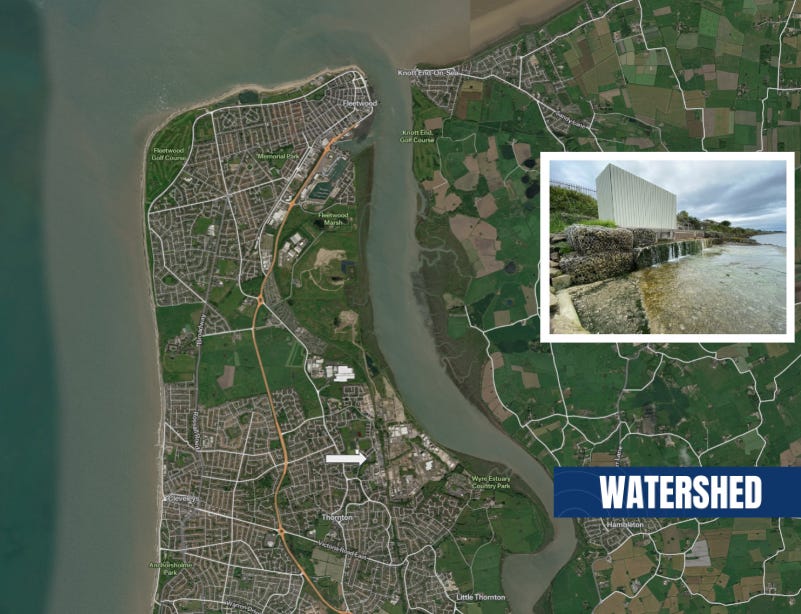
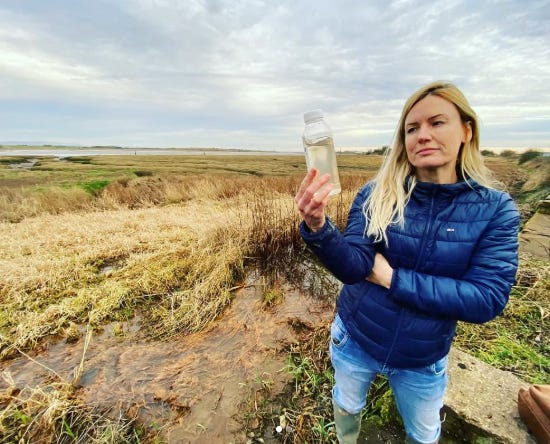
This included clambering around the Wyre estuary, taking samples of effluent coming off the site of a chemicals plant. With the help of experts and scientists including Dr Dave Megson at Manchester Metropolitan University and Prof Ian Cousins and Joost Dalmain at Stockholm University, we found the site was pumping out eye-watering levels of the banned carcinogen PFOA into the ‘protected’ river. Thankfully the site and its surrounding area is now under investigation by the Environment Agency, UK Health Security Agency, Food Standards Agency and the council. Ominously but wisely, people living around the plant have been told not to eat vegetables from their gardens. The investigations are ongoing but the Environment Agency has oddly decided against testing soils for a PFAS that the company makes and that the agency suspects is reprotoxic. Go figure. 

It was around this time that I took a call from Sara Pilz, a journalist who at the time was working at Arena for Journalism in Europe. She invited us to join a coalition of journalists – the Forever Pollution Project – led by Stephane Horel at Le Monde, to work on a Europe-wide map of PFAS pollution and we were thrilled to take part. It led to Europe-wide coverage and in the UK we ran the map with the Guardian and published our own UK investigations across the paper that week. 

Two years later and a second collaboration with the same team (this time the Forever Lobbying Project led by Horel) revealed the extent of lobbying by the chemicals sector to avoid stronger regulation of the substances, as well as the eye-watering costs of cleaning up polluted land. Again, we ran more UK investigations alongside the collaborative work. 

All of which brings me back to my first story on drinking water. Five years on and there have been improvements in guidelines, the DWI had ordered water companies to test for PFAS and results, a PFAS inquiry and much more regulatory action (albeit slow).

In January 2026, I worked with Esme Stallard and Becky Dale at the BBC on the number of water company assets afflicted with PFAS. It’s a lot. Even with patchy data it was possible to calculate that the drinking water of at least 6 million people is “at risk” according to the DWI. But at least the regulators are working on it.

A combination of painstaking research, EIR work and insider tips-offs helped me uncover PFOS contamination across a wide area of Cumbria and Lancashire in February. The race is on to work out who or what is responsible.

There has genuinely been more work by Watershed than I can squeeze into the already-too-long post. So I’ve pasted a chronological list of stories below that you can peruse at your leisure. 

Meanwhile, our difficult relationship with PFAS carries on and we will continue to report on it as long as it remains a problem. 

rachel.salvidge@watershedinvestigations.com

Life in the PFASt lane (in chronological order):

How close is Day Zero?

Rachel Salvidge

Could we run out of water? “People would be shocked if they knew just how close we’ve come to Day Zero in England,” a former Environment Agency officer told me some time ago.

Day Zero, sometimes known as the Jaws of Death by those numb to melodrama, is the time when a city or country runs out of drinking water. When the taps run dry and the standpipes or tankers are deployed. To be fair, it is quite a dramatic scenario.

To many on this damp little island that regularly floods, the idea’s preposterous. But it’s a very real threat in parts of the UK and Europe. The Environment Agency for England has warned of widespread drought next year unless there’s lots of rain over the winter and so far, it’s not looking good.

I wanted to understand what’s happening to freshwater supplies across the UK and the wider continent, to our rivers, lakes and groundwater. Groundwater (aquifers) are generally thought to be more resilient to climate change but I wanted to know how they were holding up. 

Fortunately NASA’s GRACE satellites have been orbiting the Earth for decades, and by observing changes in the gravity field, can estimate changes in the amount of water stored in a region. And more fortunately, I know some clever people who can make sense of that data. 

Working with Professor Mohammad Shamsuduhha and postdoctoral researcher Arifin, we could see stark drying and wetting trends across the UK and the continent and mapped them, revealing huge regions with shrinking water resources while others in the north look to be getting wetter, both outcomes having far reaching consequences for people, agriculture, wildlife and wider industry. 

The map and story was published in the Guardian at the weekend: 

I followed this up with a second story revealing that tensions are rising between the government, regulators and the water industry as the Environment Agency warns of a possible nationwide drought next year. Each blames the other for not factoring increasing volumes of water needed for industrial growth, including clean energy needed to hit carbon emissions reduction targets. The omission could lead to water shortages in some regions, according to new analysis.

Read more about the scrap here: 

My previous stories have revealed that it’s not clear that anyone in government or elsewhere has a handle on how much water is being taken from the environment at any one time. There are systems in place but they are patchy and disjointed and often rely on self reporting. 

I’ve also found that the Environment Agency, the regulator responsible for overseeing water taken directly from rivers and groundwater, rarely checks up on users to make sure they aren’t taking more than their licensed amount, according to whistleblowers. When you add that to the fact that the water sector loses eye-watering amounts from its creaking systems every day, the picture starts to look pretty shambolic.

Today there are flood warnings in some parts of the UK while others remain water stressed. It’s clear we need to be managing water better and it’s critical that at the very minimum we need to know who’s using what. 

Watershed is a non-profit organisation. If you value this kind of work, please consider donating so we can do more of it: https://watershedinvestigations.com/support-us/

rachel.salvidge@watershedinvestigations.com

England’s bathing water results are out, but do they tell the full story?

Rachel Salvidge

The Environment Agency has released England’s latest bathing water classifications and the headline, pushed by Defra, is that 87% of bathing waters are rated Excellent or Good. Ministers call this a “success story”. The Government press release talks about “cleaner rivers and seas”. 

But behind the spin, the data tells a more complicated story. And when set alongside Watershed’s investigation into bathing waters with scientists at the University of York, citizen scientists, and Surfers Against Sewage, it becomes clear that the government’s testing regime needs work. 

I’ve plotted the results on the Watershed Pollution Map, so you can see whether or not each site has improved year on year. 

There is some good news. The number of excellent sites rose from 289 to 297, poor sites fell from 37 to 32, sufficient sites dropped from 29 to 25. 

But when you consider that dozens of bathing waters remain badly polluted year after year, it seems less of a win…

Bathing Water Name 2025 Classification 2024 Classification
Tynemouth Cullercoats Poor Poor
Littlehaven Beach Poor Poor
Scarborough South Bay Poor Poor
Wharfe at Cromwheel, Ilkley Poor Poor
Nidd at the Lido, Knaresborough Poor Poor
Wharfe at Wilderness Carpark Poor Poor
Sheep’s Green, River Cam Poor Poor
Wolvercote Mill Stream Poor Poor
Dymchurch Poor Poor
Littlestone Poor Poor
Worthing Beach House Poor Poor
Bognor Regis (Aldwick) Poor Poor
Southsea East Poor Poor
River Avon at Fordingbridge Poor Poor
Lyme Regis Church Cliff Beach Poor Poor
Stoke Gabriel, Dart Estuary Poor Sufficient
Steamer Quay, Dart Estuary Poor Poor
Coastguards Beach, Erme Estuary Poor Poor
Dunster Beach Poor Poor
Blue Anchor West Poor Poor
River Tone at French Weir Park Poor Poor
Weston-super-Mare Uphill Slipway Poor Poor
Weston Main Poor Poor
Weston-super-Mare Sand Bay Poor Poor
River Frome at Farleigh Hungerford Poor Poor
River Teme in Ludlow  Poor Poor
River Severn at Ironbridge Poor Poor
River Severn in Shrewsbury Poor Poor
Blackpool North Poor Poor
Haverigg Poor Sufficient
Derwent Water at Crow Park Poor Poor
River Ribble at Edisford Bridge Poor Poor

And “Excellent” doesn’t always mean safe.  The EA’s classification system is based on spot samples that miss pollution incidents and tests only for two bacteria (E.coli and enterococci), it averages sample results over four years masking critical details, it samples each site only around 15 times per bathing water season (May-Sept).  It ignores a host of concerning chemicals, pharmaceuticals, superbugs and pathogens. 

Watershed’s 2024 investigation, carried out with the University of York and Surfers Against Sewage, exposed widespread contamination at popular UK swimming spots, including officially designated bathing waters. The work was shown on ITV and in The Times. 

Over a week of sampling, we found E.coli up to 22x higher than US safe limits, superbug genes that can lead to AMR and a broader chemical cocktails of pharmaceuticals, pesticides, and PFAS. 

The government says this year’s results arrive “as new reforms come into law”, including automatic de-designation after five consecutive Poor classifications and introducing flexibility for site-specific bathing seasons, which means that sites can apply to change the boundaries of their bathing season. 

This is the “first shake-up in a decade”, according to Defra. But the reforms do not introduce testing for chemicals, pharmaceuticals, or resistance genes. They do not require testing after sewage spills. They do not bring UK standards in line with US, NZ or EU thresholds. This is why campaigners — and many scientists — argue they fall far short of what is needed.

A further reform, which will look at new bathing water criteria, will come into force in May 2026 to allow guidance to be fully developed.

rachel.salvidge@watershedinvestigations.com