
“My husband died of cancer. My mum died of cancer. My sister died of cancer. My father died of cancer. My neighbours died of cancer. I have cancer in my head and a tumour in my spine.”
She doesn’t want to be named but she wants her story told. She tended her allotment, not far from a chemicals company, for decades, feeding herself and her family in what she thought was the healthiest way possible. Now she wonders whether its contaminated soils have contributed to her health conditions.
She has an extraordinarily high level of PFAS in her blood — 400 times higher than what would be considered normal, although given they’re manmade chemicals they have no right being in anyone’s blood at any level.
We’re sitting in the football clubhouse a Thornton Cleveleys in Lancashire. Around me people are waiting for or returning from a consultation after having received their blood test results.
All have PFAS in their blood. Most have high levels.
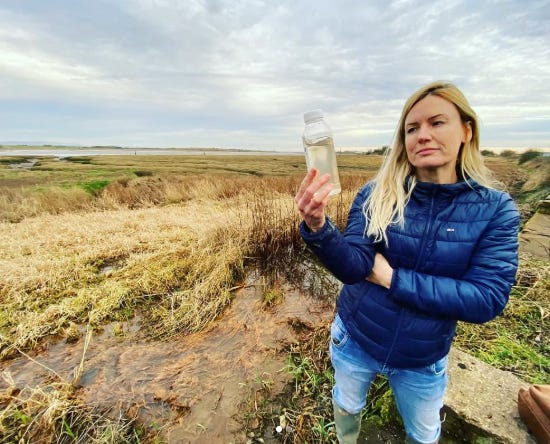
Five years earlier, my colleague Leana Hosea and I were clambering around the banks of the Wyre estuary, taking samples of effluent being discharged from the site of a chemicals company straight into the river Wyre.
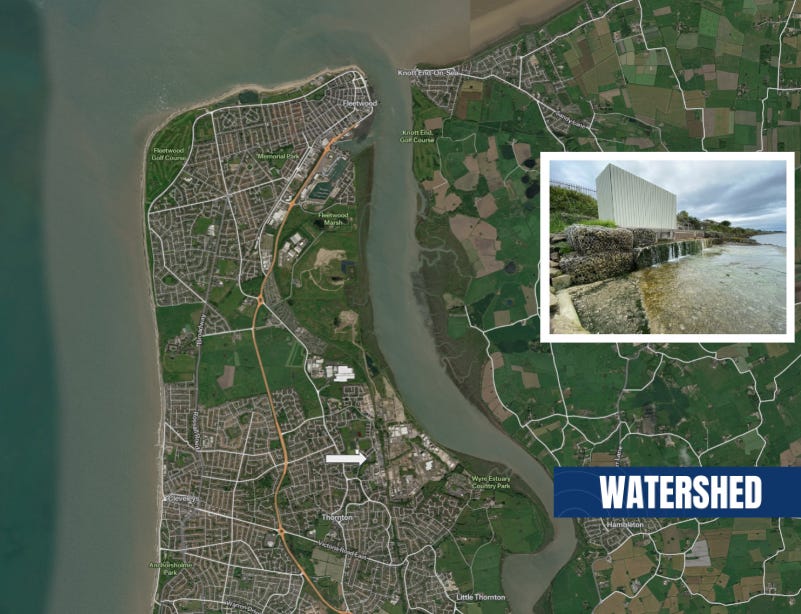
This was before Watershed — the investigative outlet we’d go on to found — even existed. We were doing it evenings and weekends around our day jobs, convinced there was a need for it.
We sent the effluent samples to Dr Dave Megson at Manchester Metropolitan University and Professor Ian Cousins and Joost Dalmain at Stockholm University who analysed them for the so-called ‘forever chemicals’.
It turned out the site was pumping eye-watering levels of PFOA — a banned carcinogen — into a legally protected river, alongside hundreds of other types of PFAS.
We published our findings with the Guardian and a multi-agency investigation followed, with the Environment Agency, the UK Health Security Agency, the Food Standards Agency and the council all involved.

Unsurprisingly but disturbingly, the agencies found PFAS in people’s allotments and gardens. Residents were told not to eat vegetables, fruit or eggs. Interestingly, the Environment Agency decided against testing local soils for a PFAS the company itself manufactures, and one the agency suspects is reprotoxic.
The investigation continues today but the community wasn’t getting any help understanding whether the contamination might be affecting their health. So we joined forces with Dave Megson again and Sarah Moore, partner at law firm Leigh Day, to offer free blood tests to people living near the chemicals plant.

I have to say at this point that the chemicals company, AGC Chemicals Europe, says the PFOA in the discharges must be from historic pollution – ICI was at the site previously – because AGC has not used PFOA since 2012, well before it was banned in 2020.

The blood test results shocked us all.
Of the 49 people tested, 69% had combined PFAS levels in the highest health-risk category used by the National Academies of Sciences, Engineering, and Medicine. The NASEM reference levels classify exposure as low risk below 2ng/ml, increased risk between 2 and 20ng/ml, and high risk above 20ng/ml. None of those tested fell into the low risk category.
The average level of PFOA was 26ng/ml, comparable with the 32.9ng/ml average found in the landmark C8 study of residents living near DuPont’s Ohio plant, made famous by the Hollywood film Dark Waters.
The highest combined PFAS result was 435ng/ml — the highest level we have found reported in the UK. Most of that was PFOA.
The highest average PFAS levels were among people living within 1km of the site, although elevated levels were also found more than 2km away.
Several households had elevated PFAS levels in more than one family member, while some of the highest burdens were found among people who had lived in the area for longer.
There was also a striking pattern around food grown at home. Every frequent consumer of home-grown eggs fell into the highest exposure category, as did 75% of those who frequently ate home-grown fruit and vegetables.

One woman, who grew up playing in the dykes behind the plant and asked not to be named, has three autoimmune diseases, cysts on her kidneys, rheumatoid arthritis, primary biliary cholangitis and temporal arteritis.
Her son was born prematurely and has cerebral palsy and ADHD.
Both her grandfathers worked for ICI on the site AGC now occupies. Both died of bowel cancer.
“We played in those dykes that ran through the houses. We ate fruit from gardens. There’s PFAS in my soils. I don’t think there’s any escaping it for anybody. Where did this all come from?”
Another was diagnosed with cancer eight years ago. “It could just be one of those things,” she told us. But she has three children heading into adult life, and on her own cul-de-sac of fifty or sixty houses, she counts six cancer diagnoses. “Could be unrelated, but they could be related. It’s a question I want answering.”
One man spent eleven years doing electrical work on ICI sites. He has fibrosis of the liver. He doesn’t drink.
A fourth woman kept hens in her garden for two years and ate the eggs the whole time. “I’ve got my little girls. I want to know if my land is contaminated. It’s my home, and it’s an asset for my children when I’m not here.”

The Environment Agency has recommended that two sets of allotments be designated as contaminated land and the council is pressing the community to hand their plots back. A third allotment has not been tested at all because it falls under a different council, despite being close to the industrial site.
It’s not possible to prove any individual’s illness is connected to PFAS. And having PFAS in your blood does not mean you will contract an illness now or in the future. What the numbers do show is that this community’s exposure to PFAS is real, measurable, and among the worst documented anywhere in the UK.
What is clear is that there need to be better understanding of exposure to PFAS and other chemicals around industrial sites like this. It’s clear the UK needs a biomonitoring programme to get a picture of national public health and to identify hotspots. It’s clear that chemicals needs much better regulation and testing before they are placed on the market.
And right now, the people of Thornton Cleveleys and the surrounding area need immediate support from their council and local health institutions.
Meanwhile, Sarah Moore is exploring legal routes for the community.
And AGC? Last week it announced it would close the its plant, citing financial difficulties.

The story ran in The Times on the front page, and the BBC and ITV covered it across their platforms.
FIND OUR PFAS STORIES HERE (CHRONOLOGICAL ORDER):
- Spikes in toxic chemicals detected in England’s rivers
- UK ‘flying blind’ on levels of toxic chemicals in tap water
- Revealed: scale of ‘forever chemical’ pollution across UK and Europe
- Toxic substances from chemicals firm site found polluting protected river
- What are PFAS, how toxic are they and how do you become exposed
- Buncefield: the PFAS legacy of ‘biggest fire in peacetime Europe’
- UK risks falling behind Europe in controlling ‘forever chemicals’
- Ministers told to get a grip on scale of ‘forever chemicals’ pollution in UK
- Is the UK absent from the fight against PFAS ‘forever chemical’ pollution?
- The growing evidence of the impact of PFAS on wildlife
- How much do we know about UK PFAS pollution?
- Fish and chips with a side of plastic
- Firm releases almost 800kg of ‘forever chemical’ a year into a Lancashire river
- Scientists call on ministers to cut limits for ‘forever chemicals’ in UK tap water
- Forever chemicals found in drinking water sources across England
- ‘Forever chemical’ in English tap water samples carcinogenic, WHO rules
- ‘Britain’s Dark Waters’
- Toxic: Britain’s forever polluted rivers and seas,
- Residents near Lancashire chemicals plant told to wash homegrown produce
- Cost of dealing with PFAS problem sites ‘frightening’, says Environment Agency
- Cost to clean up toxic PFAS pollution could top £1.6tn in UK and Europe
- Industry using ‘tobacco playbook’ to fend off ‘forever chemicals’ regulation
- 3M knew firefighting foams containing PFAS were toxic, documents show
- Bloodletting recommended for Jersey residents after PFAS contamination
- UK farmland being contaminated by ‘forever chemicals’ linked to cancers
- Revealed: drinking water sources in England polluted with forever chemicals
- ‘High-risk sites’: where are the UK’s ‘forever chemical’ hotspots?
- RAF bases are hotspots of ‘forever chemical’ groundwater pollution, MoD documents show
- UK failing to match EU in fight against ‘forever chemicals’, say scientists
- Otters among UK wildlife carrying toxic ‘forever chemicals’, analysis shows
- The Guardian view on chemical pollution: the UK can’t ignore the risks from PFAS
- Scientists warn against attempts to change definition of ‘forever chemicals’
- BBC Radio 4 Rare Earth
- Fears that UK military bases may be leaking toxic ‘forever chemicals’ into drinking water
- How ‘forever chemicals’ have seeped into almost everything – video
- Toxic Pfas above proposed safety limits in almost all English waters tested
- Cancer fears in shadow of ‘forever chemical’ plant
- Regulators overlooking toxic Pfas found around Lancashire chemicals plant
- Drinking Water Inspectorate ordered action over ‘forever chemicals’ risk
- Firms ordered to reduce forever chemicals in drinking water sources for 6 million people
- Race to find source of carcinogenic Pfas in Cumbria and Lancashire waters
- Elevated levels of ‘forever chemicals’ found in blood of residents near chemical factory
- Blood tests find high level of cancer-causing forever chemical in residents near factory
- Blood toxins at record levels in residents near chemicals plant


